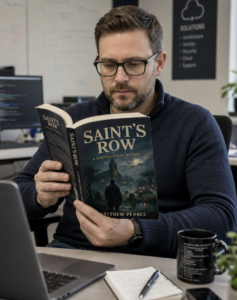
IT consultants spend their days walking into complicated environments, finding what is broken, sorting through layers of information, and helping people understand what went wrong before it gets worse. That is one reason A Mathias Green Mystery: Saint’s Row has such a strong appeal for readers who think in systems, patterns, risk, and hidden connections. This is not just a mystery about one crime. It is a story about what happens when one disturbing event exposes something much larger beneath the surface. 💻
For IT consultants who enjoy books that move with intelligence, structure, tension, and discovery, Saint’s Row offers the kind of layered storytelling that feels familiar in the best way. A failed system rarely fails in only one place. There are usually warning signs, buried decisions, overlooked details, and people who ignored the truth because fixing it would cost too much. That same kind of thinking gives this mystery its power.
Readers looking for thoughtful, suspenseful murder mystery books will find that Saint’s Row delivers more than a simple whodunit. It gives readers a puzzle with depth, consequences, and a main character who does not settle for the first answer handed to him.
A Mystery That Thinks Like a Consultant
IT consultants are trained to look past surface-level symptoms. A company may say it has a software issue, but the real problem could be outdated processes, poor communication, weak security habits, bad documentation, or leadership that refuses to change. In the same way, Saint’s Row begins with a disturbing crime, but the story quickly makes it clear that the visible problem is only the entry point.
That structure is one of the reasons this book can connect so well with consultants. Mathias Green does not simply react to what is in front of him. He studies what does not fit. He pays attention to what people avoid saying. He notices inconsistencies, missing pieces, and the pressure points inside the community. That mirrors the work of a strong IT consultant who walks into a client environment and understands that the issue on the ticket may not be the true root cause.
The consulting world continues to shift as technology becomes more central to leadership, growth, and security. According to Wikipedia’s overview of information technology consulting, IT consulting often involves advising organizations on how to use technology to meet business objectives. That blend of technical investigation and strategic thinking is exactly why a mystery like Saint’s Row can feel so engaging to someone in the field.
The Appeal of Systems, Secrets, and Root Causes
A good IT consultant understands that every system has a story. Logs tell a story. User behavior tells a story. Network slowdowns tell a story. Security gaps tell a story. The challenge is knowing how to read those signs without jumping to the wrong conclusion.
Saint’s Row works in a similar way. The crime is not isolated from the town around it. The people, the past, the records, the silence, and the fear all function like interconnected parts of a larger machine. Mathias Green has to examine the environment as much as the evidence. That makes the book especially satisfying for readers who enjoy solving problems from the inside out.
This is also why the novel fits well with the mindset of IT consultants who follow today’s technology landscape. Modern organizations are dealing with AI adoption, cybersecurity risk, data governance, and operational pressure all at once. Gartner’s Top Strategic Technology Trends for 2026 highlights major areas such as AI-native development platforms, confidential computing, preemptive cybersecurity, digital provenance, and AI security platforms. Those trends all point to the same truth: leaders need people who can see connections, detect risk, and protect trust before the damage spreads.
That is the same kind of tension that makes Saint’s Row compelling. One hidden weakness can affect everything. One ignored detail can change the meaning of the entire case.
Mathias Green Is Built for Readers Who Like Precision
IT consultants often appreciate characters who are precise without being robotic. Mathias Green fits that space well. He is not the kind of investigator who depends only on instinct or drama. He thinks. He studies. He follows evidence. He understands that the truth is rarely sitting neatly on the surface waiting to be accepted.
That kind of character can be especially refreshing for readers who enjoy intelligent mysteries. Mathias is not simply chasing a villain. He is tracing a structure. He is looking at how people, records, institutions, and old decisions connect. For consultants who spend their careers untangling messy systems, that kind of investigation feels satisfying because it respects the reader’s intelligence.
There is also a strong professional parallel here. CIO.com’s discussion of digital transformation in 2026 points to the growing need for organizations to focus on business value, data governance, security, and stronger operating models. Consultants are not just asked to install tools anymore. They are asked to help leaders understand what must change. Mathias Green operates with that same deeper lens. He is not only looking for the person responsible. He is looking for the reason the truth stayed buried.
A Story About Trust, Risk, and Consequences
Trust is one of the biggest themes in both consulting and mystery fiction. A client has to trust the consultant’s judgment. A team has to trust the system they depend on. A community has to trust that truth matters. When trust breaks, the damage spreads quickly.
In Saint’s Row, trust has been damaged in ways that are personal, institutional, and dangerous. That gives the book more weight than a simple puzzle. The mystery matters because the consequences matter. Readers are not only turning pages to find out who committed a crime. They are pulled into the larger question of how much damage can happen when people protect secrets instead of people.
This theme connects naturally to the modern IT world. NIST’s AI Risk Management Framework focuses on helping organizations better manage risks tied to artificial intelligence, trustworthiness, and responsible technology use. For consultants, trust is no longer just a soft value. It is part of cybersecurity, compliance, operations, vendor selection, and leadership. Saint’s Row gives that same concept a fictional but emotionally gripping shape.
The result is a mystery that feels relevant to people who understand that behind every system are human choices. Technology may fail, but people decide what to ignore, what to hide, what to document, and what to repair.
Why IT Consultants Will Enjoy the Pace and Problem-Solving
IT consultants are used to working under pressure. There are deadlines, outages, client expectations, budget concerns, and technical surprises. That makes a mystery with strong pacing especially enjoyable. Saint’s Row has the kind of premise that keeps the reader moving because each discovery raises the stakes instead of closing the case too quickly.
The book’s setup creates momentum. A ritual murder in a dying church could have stayed focused on one killer, but the story opens into something broader and more dangerous. That kind of escalation gives readers the feeling of moving deeper into a system where every layer reveals another hidden dependency.
Consultants who follow cybersecurity and AI developments will also appreciate how much today’s professional world depends on anticipation. CISA’s guide on the secure adoption of agentic AI reflects how organizations now have to think ahead before powerful tools introduce new risks. The same mindset applies to mystery fiction. The best investigators do not wait for the next disaster. They study the pattern before it repeats.
That is where Saint’s Row shines. It rewards readers who pay attention.
A Strong Fit for Consultants Who Love Strategy
Many IT consultants enjoy books that make them think strategically. They do not want a story where everything is obvious too soon. They want tension, but they also want substance. They want clues that matter, motives that hold weight, and a final picture that feels earned.
Saint’s Row fits that reading style because the story invites analysis. The setting, the crime, the town, and the silence around the truth all create a strategic puzzle. Mathias Green has to read people as carefully as evidence. He has to understand the pressure behind the facts. That gives the novel a professional edge that can appeal to consultants, analysts, cybersecurity advisors, systems thinkers, and anyone who enjoys solving complex problems.
McKinsey’s Technology Trends Outlook 2025 notes the increasing importance of AI, agentic AI, cybersecurity, infrastructure investment, governance, and workforce adaptation. Those topics matter because organizations are becoming more complex, not less. The professionals who thrive are the ones who can think clearly inside complexity. That is also what makes a mystery like Saint’s Row enjoyable. It is not just about finding an answer. It is about understanding the structure that made the answer possible.
A Book That Gives the Brain Something to Work On
Some novels are easy escapes. Others give the reader something to wrestle with. A Mathias Green Mystery: Saint’s Row offers both. It gives suspense, atmosphere, danger, and discovery, but it also gives readers the pleasure of thinking through a layered problem.
That is exactly why IT consultants may find it so appealing. Their work often requires patience, pattern recognition, and the ability to stay calm when everyone else wants a fast answer. Mathias Green brings that same energy to the page. He does not accept the convenient explanation. He keeps digging until the larger truth begins to show itself.
Recent reporting from CIO.com on global IT spending growth shows how much money and attention continue to move into AI infrastructure, software, cloud, and related technology investments. With that growth comes more complexity, more risk, and more demand for people who can solve problems with discipline. That is the kind of reader who can appreciate a mystery built around hidden systems, buried truth, and one investigator determined to uncover what others missed. 🔎
Conclusion
What IT Consultants Will Love About A Mathias Green Mystery: Saint’s Row comes down to more than genre. This is a mystery for readers who enjoy intelligence, structure, pressure, and discovery. It gives consultants a story that reflects the way they already think: look deeper, question the first answer, follow the evidence, and understand how one broken part can expose an entire system.
For IT consultants who spend their careers solving hard problems, protecting trust, and helping people see what they have missed, Saint’s Row offers a gripping fictional experience with a familiar kind of satisfaction. It is suspenseful, thoughtful, and built for readers who know that the truth is often hidden in the details everyone else overlooked.